Showing posts with label Edith Annie Hawks. Show all posts

Sunday, May 5, 2013

Edith Annie Hawks – by Lynne Thomas Cannon


Edith Annie Hawks was born and raised in Halling, Kent, England.  From her childhood she remembers one night her sisters coaxed her to climb out the window and jump across to the lean-to roof and pick some sweet white grapes for them.  After picking the grapes she found that she could not get back.  She had to slide down the lean-to room into the water-filled rain barrel in her nightgown.

Edith’s family and all her neighbors kept a neat garden plot behind their house.  Edith’s family also kept some young pigs in a brick house in the back yard.  One day one of the pigs got out.  All the neighbors tried to help them catch the pig, but it ran into the outhouse and jumped into the hole, hanging by its front legs.  Edith ran to get her father.  With the help of the neighbors, they got the pig out and into a tub of water and then into a gunnysack.  When the pigs were butchered, one of Edith’s sisters played the mandolin and her brother Freddy played the violin to drown out the squealing of the pig.

In the backyard there was also a “voluntary” apple tree which never had fruit.  Edith’s father got a slip from another tree, a white Jonathon slip, and grafted it by cutting a slit in the bark and cementing the slip in and closing it with adhesive.  The graft grew and had on apple on it.

Edith’s family had a two wheeled cart on one axle which was called a dog cart.  Edith was hanging onto the back of the wagon one day as it was going up a steep hill leading up to the neighborhood bakery.  The wagon tipped back and Edith was caught between the axle and the wagon.  She had to stick her head further under the cart to keep form getting smashed.

One day when Edith was about nine years old she found a rabbit that had been caught in a snare by a poacher.  She got the rabbit out of the snare which was like a slipknot of string and wrapped it in her pinafore.  She took it home for dinner.  When telling the story, Edith said, “ I can still feel it scratching.”  Edith was called Nancy Patient Day by her friends.

Edith Annie Hawks was confirmed into the Episcopal Church at age fourteen by the Archbishop of Canterbury.  At age fifteen she was apprenticed in dry goods and general merchandising at Durrant and Harrison in Snodland.  She was apprenticed for three years after which she was offered a job with the same firm and worked for them for one year.  As a part of her apprenticeship she received room and board and at the end of her apprenticeship she received twenty-five pounds.

At age nineteen Edith left for Camberwell, London with only two and six pence (75 cents).  She obtained a position with Mackie Bros. as a buyer of baby linen.  Her first pay for this position would not be until three moths after beginning work.  Edith worked for Mackie Bros. For four years and then went to Canham’s Dry Goods at Mortlake on the Thames.  For Canham’s she was a window-trimmer and made and sold millinery.  She worked for Canham for four years.  This was where she was working when Ernest returned and made her his bride. 

ERNEST JOHN THOMAS


Ernest John Thomas – by Lynne Thomas Cannon

Ernest John Thomas was apprenticed as a sailmaker to his father’s employer, Lee & Co. at age thirteen.  Ernest wanted to be able to continue to attend school.  But, as the only son, his parents didn’t want him to live so far away from home.  Apparently, would have had to go to school in Wales where there was probably some family property.  Ernest also always wanted to become a seaman, but his parents forbade it.  Ernest never forgave them.

Instead, Ernest served an apprenticeship for six years in his own hometown and then got a job in a shipyard in Strood, another town very close to home.  While living in England, Ernest walked a great deal, all through the south of England.  But, what he really wanted to do was to go to Canada.  Many people were going to Canada at that time, looking for opportunities.  Ernest John Thomas mad his first trip to Canada on a White Star Liner steamship when he was probably in his early twenties.

Ernest arrived in Montreal, Quebec and found plenty of work available.  First, he went to work in the country raising flax.  Then he worked on another farm where he made friend with some fellows from Toronto.  He moved to Toronto, Ontario and lived in boarding houses.  He worked in a piano factory, a foundry and a bakery.  He also worked for a Mr. Turner in Peterborough in a tent factory.*

After some time in Canada, Ernest went to Chicago in answer to an advertisement for sailmaker.  He worked there for a time and then went to Massachusetts, working in Boston, Fall River and New Bedford.  Ernest also went to Philadelphia and New York.  In New Your City, Ernest worked on Fulton Street and lived in Brooklyn.  He walked across the Brooklyn Bridge to work and back every day.

San Francisco 1906 earthquake
Ernest returned to England but he only stayed about two months before sailing again for Canada.  This time he went to Winnipeg, Manitoba, Alberta, and Vancouver, British Columbia.  During this trip he also went to San Francisco.  While in San Francisco he went walking down by the ships alone one night.  He met a sailor who took him aboard ship and tried to drug him and shanghai him, but he escaped.  He was in San Francisco right after the big earthquake which was April 18th and 19th, 1906.  He was conscripted into helping clean up after the earthquake.  Ernest returned to England sometime shortly before his marriage to Edith Annie Hawks on May 12, 1910.


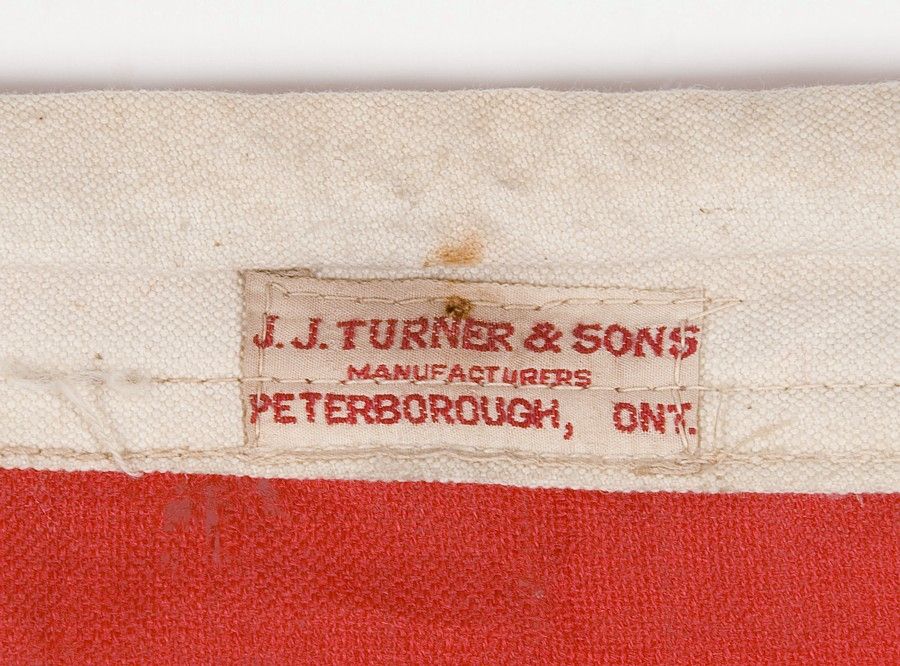
UNION JACK, MADE BY J.J. TURNER & SONS image 2*J.J. Turner & Sons; Manufacturers; Peterborough, Ont. [Ontario] The following information is taken from the archives of the Peterborough Museum: “The J.J. Turner Company was established about 1870 in Port Hope, Ontario. It re-located to Peterborough in 1887. In 1914 the company was described as the largest maker of tents, sails and awnings in Canada. In 1908 it employed 68 workers in a 20,000 square foot factory in downtown Peterborough. It was at one time, among Peterborough's ten largest employers. The factory contained a blacksmiths shop, carpentry shop and other large scale workshops. J.J. Turner also had a nation-wide marketing and distribution network”. In a 1920 catalogue, Turner listed itself as a maker of “sails, tents, awnings, flags, and camp equipment.  For at least part of its existence, the company was located at 140 King Street. The building still exists today and is known as the J.J. Turner Building. The company still existed in 1975 under the name Turner Company.

EDITH ANNIE HAWKS


Grandma’s Story – by Ruby Thomas

When I first met your Grandpa, ‘twas at the undertaker’s you know,
It happened this was my uncle – and my sister was there with her beau.
She introduced me to your Grandpa and he asked to walk me home. 
After that, as I remember, most every Sunday he would come. 
We’d go to church together, and we’d walk the countryside. 
And soon we had an understanding that some day I’d be his bride.

But your Grandpa had the wanderlust – he’d look across the sea,
And talk of leaving England and to sailing off with me. 
Well, I didn’t want to go, and I could see he couldn’t stay, 
So I said, “You go without me,” and he really did one day.

Three long years he spent in Canada and in United States. 
I thought I’d seen the last of him, but my heart still seemed to wait. 
Then one Easter morning I saw him sitting there in church,
A lovely girl beside him - and my heart gave such a lurch.
After the service he introduced her, she was his sister don’t you see.  
How glad I was to see him.  And he seemed glad to be with me.  

What a shock to have him tell me he was sailing off again next day.  
But before he left he gave me presents which must have used up half his pay: 
A diamond bracelet and a necklace, a watch and an engagement ring! 
I knew then that he’d return to me, and my heart began to sing.

We were married Friday morning, May 12th, 1910, 
and I determined not to let him get so far away again.  
We paid for a special license to be married without delay, 
for we must catch a boat to Canada the very next day.

We lived in Peterborough, Ontario for about six weeks or so,
Then moved to Salt Lake City.  Can it be so long ago? 
Fifty years now we've been married – and I’ve seen a lot of men, 
but if I had to do it over, I’d be your Grandpa’s bride again.

Ernest John Thomas + Edith Annie Hawks


Edith and Ernest – by Lynne Thomas Cannon

Even though Edith Annie Hawks and Ernest John Thomas lived right nest door to each other in two little neighboring towns, they didn’t meet until about 1901 in London.  Edith had an Uncle Hawks who was an undertaker in London.  One day when she stopped by his place of business, she found her sister Daisy there with her beau, John Beach, and another young man named Ernest John Thomas.  They were introduced and he asked if he could walk her home.  Following that beginning, they often went out walking and to church together.  After five weeks of courtship Ernest kissed Edith.  They kept company for two years.  Once, during this courtship they went together to the home of Rudyard Kipling in Sussex.  They expected to meet him but were unable to do so.  They also know Lloyd George before he was Prime Minister.  Edith had been in his home.  Edith and Ernest became engaged.  They were known as Annie and Ernie to their friends.
MONET: Charing Cross Bridge, London (1901)
MONET: Charing Cross Bridge, London 1901


Ernest John Thomas was always talking about crossing the ocean, so Edith wrote him a letter telling him that he should go with no ties, the engagement was off.  He left for Canada.  She did not hear from him for three years.  Then, one Sunday when she was home for Easter, She went to church with her two sisters and their beaus.  The church was filled.  There were three seats together near the front.  On her way to her seat with her sisters, Edith saw Jack (as she called him) sitting with a girl – she blushed!  He didn’t see her.  After the services, she saw him waiting outside and he introduced her to the girl, his sister Mabel.  Edith and Ernest walked home together.  Ernest said, “On the way past my house, come in and wait while my father helps me out with my trunks, as I am sailing tomorrow for America.”  He had been in town for a month without her knowing.  Ernest said, “See you in the morning.”  He was planning on taking his three sisters to London in the morning to the Crystal Palace Resort.

Perhaps Ernest delayed his sailing for a few days or weeks.  But, within a month he had sailed for America.  Before he sailed, Edith and Ernest had become engaged again.  On the Monday following Easter Edith and Ernest went for a walk in the forest.  On Tuesday Ernest went to London and bought Edith a diamond ring, a watch, a bracelet, and a necklace – a matched set.

Ernest was gone for another three of four years.  But, this time when he returned, Edith and Ernest were married.  Ernest paid the twenty-five pounds for the special license so they would not have to wait three weeks to have their banns read in church.  They were married May 12, 1910 in Kingston on the Thames by a Justice of the Peace on a Friday morning.  Edith’s sister Lillian and her husband, Frederick Smith, were the witnesses.  Edith and Ernest spent Friday night at Lillian’s home in Teddington and Saturday morning they sailed for Canada.

The ship docked in Montreal and Edith and Ernest took a day’s train ride from there to Peterborough, Ontario where they rented a house with three rooms upstairs an three down.  Ernest arranged for some furnishings and the necessities to set up housekeeping for his new bride.  But, as the story goes, Edith hated Peterborough and would not stay.  After six weeks, Ernest did what he could with the furniture and moved his wife to Salt Lake City, saying, “I know a place you will love.”  Well, she didn’t love it, but Ernest couldn’t afford to move them again and that is how we all came to be residents of Salt Lake City.

Ernest had been in Salt Lake before and was immediately attracted to the place and had a feeling that it would be a good place to live.  Ernest got a job at a canvas factory working for Mr. Rippey.  It is believed that Ernest had worked for him before, while living with the Evans sisters, later a well-known singing trio.

Arriving in Salt Lake, Edith and Ernest first lived about a month with Mrs. Smith on Third East and Fifth South while waiting for their home to be finished.  Soon they moved into their home on Fifth South between Fourth and Fifth East.  They paid eighteen dollars a month in rent.  Both Bill and Owen were born at this residence.  In 1913 the family moved to 428 East Ninth South where Evelyn was born.  In 1917 they moved to 356 East Eight South where Kent was born.

AAA Tent  Awning in the early 1940s
AAA Tent and Awning Company in the early 1940's
Ernest eventually went into business with Lawrence Nink and formed AAA Tent and Awning Company.  The business was first located on State Street between Second and Third South.  Some years later there was a fire after which the business moved to Second South between State and Second East.  It was said that this fire was the best thing that ever happened in the business.  The fire destroyed the floor of the basement.  The insurance company deemed the machines a total loss.  Ernest bought the machines back from the insurance company as damaged merchandise, repaired them and bought new machines with the insurance money, essentially doubling the business.

The rest of the story is probably more well known by others in the family.  Many entertaining stories could be told about Ernest and Edith and the Thomas family and maybe this coming year would be a good time to start gathering those stories.